what does it mean to support animal welfare
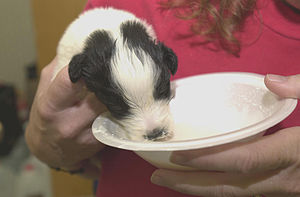
Brute welfare is the well-existence of non-human animals. Formal standards of animal welfare vary betwixt contexts, but are debated mostly past animal welfare groups, legislators, and academics.[1] [two] Animal welfare science uses measures such every bit longevity, illness, immunosuppression, behavior, physiology, and reproduction,[3] although there is argue most which of these best indicate animal welfare.
Respect for animal welfare is often based on the belief that nonhuman animals are sentient and that consideration should exist given to their well-being or suffering, especially when they are under the care of humans.[iv] These concerns can include how animals are slaughtered for food, how they are used in scientific inquiry, how they are kept (as pets, in zoos, farms, circuses, etc.), and how human being activities affect the welfare and survival of wild species.
There are 2 forms of criticism of the concept of animal welfare, coming from diametrically reverse positions. 1 view, held by some thinkers in history, holds that humans have no duties of whatsoever kind to animals. The other view is based on the animal rights position that animals should not be regarded as property and any use of animals by humans is unacceptable. Accordingly, some animal rights proponents argue that the perception of better brute welfare facilitates continued and increased exploitation of animals.[v] [6] Some regime therefore care for animal welfare and animal rights as 2 opposing positions.[7] [ page needed ] [8] [9] Others see animal welfare gains as incremental steps towards fauna rights.
The predominant view of mod neuroscientists, still philosophical problems with the definition of consciousness even in humans, is that consciousness exists in nonhuman animals.[10] [11] Notwithstanding, some nonetheless maintain that consciousness is a philosophical question that may never be scientifically resolved.[12] Remarkably, a new study has managed to overcome some of the difficulties in testing this question empirically, and devised a unique way to dissociate conscious from nonconscious perception in animals.[13] In this study conducted in rhesus monkeys, the researchers built experiments predicting completely contrary behavioral outcomes to consciously vs. non-consciously perceived stimuli. Strikingly, the monkeys' behaviors displayed these verbal reverse signatures, just like aware and unaware humans tested in the written report.
History, principles, and practice [edit]
Fauna protection laws were enacted every bit early as 13th century AD by Genghis Khan in Mongolia, where they protected wildlife during breeding flavor (March to October).[14]
Early on legislation in the Western world on behalf of animals includes the Ireland Parliament (Thomas Wentworth) "An Act against Plowing past the Tayle, and pulling the Wooll off living Sheep", 1635, and the Massachusetts Colony (Nathaniel Ward) "Off the Bruite Creatures" Liberty 92 and 93 in the "Massachusetts Body of Liberties" of 1641.[15]
In 1776, English chaplain Humphrey Primatt authored A Dissertation on the Duty of Mercy and Sin of Cruelty to Brute Animals, one of the first books published in support of animal welfare.[xvi] [17] Marc Bekoff has noted that "Primatt was largely responsible for bringing animal welfare to the attention of the general public."[18]
Since 1822, when Irish MP Richard Martin brought the "Cruel Treatment of Cattle Act 1822" through Parliament offering protection from cruelty to cattle, horses, and sheep, an animal welfare movement has been active in England. Martin was among the founders of the world's showtime creature welfare organization, the Society for the Prevention of Cruelty to Animals, or SPCA, in 1824. In 1840, Queen Victoria gave the society her approving, and it became the RSPCA. The society used members' donations to employ a growing network of inspectors, whose task was to identify abusers, assemble show, and report them to the authorities.
In 1837, the German language minister Albert Knapp founded the kickoff German animal welfare society.[19]
One of the get-go national laws to protect animals was the United kingdom of great britain and northern ireland "Cruelty to Animals Act 1835" followed by the "Protection of Animals Act 1911". In the US it was many years until there was a national police to protect animals—the "Animal Welfare Act of 1966"—although there were a number of states that passed anti-cruelty laws between 1828 and 1898.[20] In India, animals are protected by the "Prevention of Cruelty to Animals Deed, 1960".
Pregnant progress in creature welfare did not take identify until the tardily 20th century.[21] In 1965, the U.k. authorities commissioned an investigation—led past Professor Roger Brambell—into the welfare of intensively farmed animals, partly in response to concerns raised in Ruth Harrison'southward 1964 book, Creature Machines. On the basis of Professor Brambell'southward report, the UK government prepare the Subcontract Animal Welfare Advisory Committee in 1967, which became the Farm Creature Welfare Council in 1979. The committee's kickoff guidelines recommended that animals require the freedoms to "stand up, lie downwards, turn effectually, groom themselves and stretch their limbs." The guidelines have since been elaborated upon to become known every bit the Five Freedoms.[22]
In the UK, the "Animal Welfare Deed 2006" consolidated many unlike forms of creature welfare legislation.
A number of animal welfare organisations are candidature to achieve a Universal Declaration on Animal Welfare (UDAW) at the United Nations. In principle, the Universal Proclamation would telephone call on the United nations to recognise animals as sentient beings, capable of experiencing pain and suffering, and to recognise that fauna welfare is an issue of importance as office of the social evolution of nations worldwide. The campaign to achieve the UDAW is being co-ordinated by World Animal Protection, with a cadre working group including Compassion in Globe Farming, the RSPCA, and the Humane Society International (the international branch of HSUS).[23] [24]
The 2019 Un Global Sustainable Development Report identified animal welfare as one of several key missing bug in the 2030 Calendar for Sustainable Development.[25]
Animate being welfare science [edit]
Fauna welfare science is an emerging field that seeks to answer questions raised by the keeping and apply of animals, such every bit whether hens are frustrated when confined in cages,[26] whether the psychological well-existence of animals in laboratories can be maintained,[27] and whether zoo animals are stressed by the ship required for international conservation.[28] Ireland leads research into farm animal welfare with the recently published Research Report on Farm Animal Welfare.
Fauna welfare issues [edit]
- Fauna testing
- Abased pets
- Behavioral enrichment
- Blood sport
- Cruelty to animals
- Feral cat
- Hunting
- Overpopulation in companion animals
- Overview of discretionary invasive procedures on animals
- Poaching
- Puppy mills
- Whaling
Farmed animals [edit]
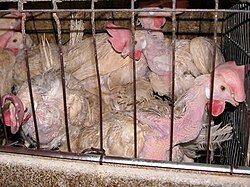
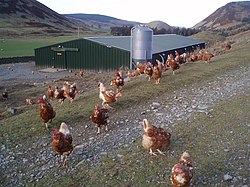

The welfare of egg laying hens in bombardment cages (top) can be compared with the welfare of free range hens (heart and bottom) which are given access to the outdoors. However, brute welfare groups contend that the vast majority of free-range hens are still intensively confined (lesser) and are rarely able to become outdoors.[29] [thirty] [31]
A major concern for the welfare of farmed animals is manufactory farming in which large numbers of animals are reared in confinement at high stocking densities. Issues include the limited opportunities for natural behaviors, for example, in bombardment cages, veal and gestation crates, instead producing abnormal behaviors such every bit tail-bitter, cannibalism, and feather pecking, and routine invasive procedures such equally neb trimming, castration, and ear notching. More extensive methods of farming, eastward.g. free range, tin can also raise welfare concerns such equally the mulesing of sheep, predation of stock by wild animals, and biosecurity.
Farmed animals are artificially selected for production parameters which sometimes impinge on the animals' welfare. For example, broiler chickens are bred to exist very big to produce the greatest quantity of meat per animal. Broilers bred for fast growth have a high incidence of leg deformities because the big breast muscles cause distortions of the developing legs and pelvis, and the birds cannot support their increased body weight. As a consequence, they often become lame or endure from cleaved legs. The increased body weight likewise puts a strain on their hearts and lungs, and ascites often develops. In the Britain alone, upwards to xx million broilers each yr die from the stress of catching and transport earlier reaching the slaughterhouse.[32]
Another business concern almost the welfare of farmed animals is the method of slaughter, particularly ritual slaughter. While the killing of animals need not necessarily involve suffering, the general public considers that killing an animal reduces its welfare.[33] This leads to further concerns most premature slaughtering such as chick alternative by the laying hen industry, in which males are slaughtered immediately later hatching because they are superfluous; this policy occurs in other farmed animal industries such as the production of goat and cattle milk, raising the same concerns.
Cetaceans [edit]
Captive cetaceans are kept for brandish, research and naval operations. To raise their welfare, humans feed them fish which are dead, but are disease-free, protect them from predators and injury, monitor their health, and provide activities for behavioral enrichment. Some are kept in lagoons with natural soil and vegetated sides.[34] Most are in concrete tanks which are piece of cake to clean, but echo their natural sounds dorsum to them.[35] [36] They cannot develop their ain social groups, and related cetaceans are typically separated for brandish and breeding. Military dolphins used in naval operations swim free during operations and grooming, and return to pens otherwise.[37] Captive cetaceans are trained to present themselves for claret samples, health exams and noninvasive breath samples above their blow holes.[38] Staff can monitor the captives afterwards for signs of infection from the procedure.
Research on wild cetaceans leaves them free to roam and make sounds in their natural habitat, eat live fish, face predators and injury, and form social groups voluntarily. However boat engines of researchers, whale watchers and others add substantial noise to their natural environment, reducing their power to echolocate and communicate.[39] [40] Electric engines are far quieter, but are not widely used for either enquiry or whale watching, even for maintaining position, which does not require much ability.[41] [42] Vancouver Port offers discounts for ships with quiet propeller and hull designs.[43] Other areas have reduced speeds.[44] Boat engines also accept unshielded propellers, which cause serious injuries to cetaceans who come close to the propeller.[45] The U.s.a. Coast Guard has proposed rules on propeller guards to protect human swimmers, but has not adopted whatsoever rules.[46] [47] The US Navy uses propeller guards to protect manatees in Georgia.[48] Ducted propellers provide more efficient drive at speeds upwards to ten knots, and protect animals beneath and beside them, but need grilles to prevent injuries to animals drawn into the duct.[49] [50] Attaching satellite trackers and obtaining biopsies to measure pollution loads and DNA involve either capture and release, or shooting the cetaceans from a altitude with dart guns.[51] A cetacean was killed by a fungal infection afterwards being darted, due to either an incompletely sterilized sprint or an infection from the ocean inbound the wound caused by the dart.[52] Researchers on wild cetaceans have not still been able to utilize drones to capture noninvasive breath samples.
Other harms to wild cetaceans include commercial whaling, ancient whaling, migrate netting, ship collisions, water pollution, noise from sonar and reflection seismology, predators, loss of prey, disease. Efforts to enhance the life of wild cetaceans, besides reducing those harms, include offering man music.[53] [54] Canadian rules do non forbid playing quiet music, though they forbid "dissonance that may resemble whale songs or calls, under water".[55]
Wild animal welfare [edit]
In add-on to cetaceans, the welfare of other wild animals has likewise been studied, though to a lesser extent than that of animals in farms. Research in wild animal welfare has two focuses: the welfare of wild animals kept in captivity and the welfare of animals living in the wild. The one-time has addressed the state of affairs of animals kept both for human use, equally in zoos or circuses, or in rehabilitation centers.[56] [57] [58] The latter has examined how the welfare of non-domesticated animals living in wild or urban areas are afflicted past humans or natural factors causing wild animal suffering.[59] [60] [61]
Some of the proponents of these views have advocated for carrying out conservation efforts in ways that respect the welfare of wild animals,[62] within the framework of the disciplines of empathetic conservation[63] and conservation welfare,[64] while others have argued in favor of improving the welfare of wild animals for the sake of the animals, regardless of whether at that place are any conservation issues involved at all.[65] [66] The welfare economist Yew-Kwang Ng, in his 1995 "Towards welfare biology: Evolutionary economic science of animal consciousness and suffering", proposed welfare biology equally a research field to report "living things and their environment with respect to their welfare (defined every bit cyberspace happiness, or enjoyment minus suffering)."[67]
Legislation [edit]
Eu [edit]
The European Commission's activities in this surface area kickoff with the recognition that animals are sentient beings.[68] The general aim is to ensure that animals practise not endure avoidable pain or suffering, and obliges the owner/keeper of animals to respect minimum welfare requirements.[68] European Spousal relationship legislation regarding farm animal welfare is regularly re-drafted according to science-based prove and cultural views.[69] [seventy] For example, in 2009, legislation was passed which aimed to reduce brute suffering during slaughter[71] and on one January 2012, the European Wedlock Council Directive 1999/74/EC came into deed, which ways that conventional battery cages for laying hens are now banned beyond the Union.
United Kingdom [edit]
The Beast Welfare Act 2006[72] makes owners and keepers responsible for ensuring that the welfare needs of their animals are met. These include the need: for a suitable environment (identify to live), for a suitable diet, to showroom normal beliefs patterns, to be housed with, or autonomously from, other animals (if applicable), and to be protected from hurting, injury, suffering and disease. Anyone who is cruel to an animal, or does not provide for its welfare needs, may exist banned from owning animals, fined up to £20,000 and/or sent to prison for a maximum of six months.[73]
In the UK, the welfare of research animals being used for "regulated procedures" was historically protected by the Animals (Scientific Procedures) Human activity 1986 (ASPA) which is administrated by the Habitation Part. The Deed defines "regulated procedures" every bit fauna experiments that could potentially cause "pain, suffering, distress or lasting harm" to "protected animals". Initially, "protected animals" encompassed all living vertebrates other than humans, but, in 1993, an amendment added a single invertebrate species, the mutual octopus.[74]
Primates, cats, dogs, and horses have additional protection over other vertebrates under the Act. Revised legislation came into strength in January 2013. This has been expanded to protect "...all living vertebrates, other than man, and any living cephalopod. Fish and amphibia are protected once they can feed independently and cephalopods at the point when they hatch. Embryonic and foetal forms of mammals, birds and reptiles are protected during the terminal third of their gestation or incubation catamenia." The definition of regulated procedures was also expanded: "A procedure is regulated if it is carried out on a protected animal and may cause that animal a level of pain, suffering, distress or lasting impairment equivalent to, or higher than, that acquired by inserting a hypodermic needle co-ordinate to proficient veterinary practice." Information technology also includes modifying the genes of a protected fauna if this causes the creature pain, suffering, distress, or lasting damage. The ASPA also considers other issues such as animate being sources, housing conditions, identification methods, and the humane killing of animals.[75]
Those applying for a license must explain why such research cannot exist done through not-animal methods. The project must likewise pass an ethical review panel which aims to determine if the potential benefits outweigh any suffering for the animals involved.
Usa [edit]
In the Usa, a federal police called the Humane Slaughter Act was designed to decrease suffering of livestock during slaughter.[76]
The Georgia Animal Protection Human activity of 1986 was a state law enacted in response to the inhumane treatment of companion animals by a pet store chain in Atlanta.[77] The Deed provided for the licensing and regulation of pet shops, stables, kennels, and animate being shelters, and established, for the get-go time, minimum standards of care. Boosted provisions, called the Humane Euthanasia Human action, were added in 1990,[78] and then further expanded and strengthened with the Creature Protection Act of 2000.[79]
In 2002, voters passed (by a margin of 55% for and 45% confronting) Amendment 10 to the Florida Constitution banning the confinement of meaning pigs in gestation crates.[80] In 2006, Arizona voters passed Proposition 204 with 62% support; the legislation prohibits the confinement of calves in veal crates and breeding sows in gestation crates. In 2007, the Governor of Oregon signed legislation prohibiting the solitude of pigs in gestation crates[81] and in 2008, the Governor of Colorado signed legislation that phased out both gestation crates and veal crates.[82] [83] Besides during 2008, California passed Proposition 2, known equally the "Prevention of Subcontract Fauna Cruelty Human activity", which orders new infinite requirements for subcontract animals starting in 2015.

The use of animals in laboratories remains controversial. Beast welfare advocates push for enforced standards to ensure the health and safety of those animals used for tests.
In the US, every institution that uses vertebrate animals for federally funded laboratory research must have an Institutional Animal Care and Employ Committee (IACUC).[84] Each local IACUC reviews research protocols and conducts evaluations of the institution's fauna care and use which includes the results of inspections of facilities that are required by police. The IACUC committee must assess the steps taken to "raise brute well-being" before inquiry can have place. This includes inquiry on farm animals.[85]
According to the National Institutes of Health Part of Laboratory Animal Welfare, researchers must try to minimize distress in animals whenever possible: "Animals used in research and testing may experience pain from induced diseases, procedures, and toxicity. The Public Wellness Service (PHS) Policy and Beast Welfare Regulations (AWRs) state that procedures that crusade more than than momentary or slight pain or distress should be performed with appropriate sedation, analgesia, or anesthesia.[85]
Still, research and testing studies sometimes involve hurting that cannot be relieved with such agents because they would interfere with the scientific objectives of the study. Accordingly, federal regulations require that IACUCs determine that discomfort to animals will be limited to that which is unavoidable for the conduct of scientifically valuable research, and that unrelieved pain and distress will only continue for the duration necessary to accomplish the scientific objectives. The PHS Policy and AWRs further state that animals that would otherwise suffer severe or chronic pain and distress that cannot be relieved should be painlessly killed at the end of the process, or if appropriate, during the process."[85]
The National Research Quango's Guide for the Care and Utilize of Laboratory Animals too serves as a guide to amend welfare for animals used in research in the US.[86] The Federation of Creature Science Societies' Guide for the Care and Employ of Agricultural Animals in Research and Instruction is a resource addressing welfare concerns in farm animate being research.[87] Laboratory animals in the United states are also protected under the Animal Welfare Act. The Us Section of Agriculture Beast and Plant Health Inspection Service (APHIS) enforces the Brute Welfare Deed. APHIS inspects beast research facilities regularly and reports are published online.[88]
According to the U.S. Department of Agriculture (USDA), the full number of animals used in the U.Due south. in 2005 was almost one.2 million,[89] but this does non include rats, mice, and birds which are not covered by welfare legislation only make up approximately 90% of research animals.[90] [91]
Approaches and definitions [edit]
At that place are many different approaches to describing and defining fauna welfare.
Positive weather condition – Providing good creature welfare is sometimes defined by a list of positive atmospheric condition which should be provided to the animate being. This approach is taken by the V Freedoms and the iii principles of Professor John Webster.
The Five Freedoms are:
- Freedom from thirst and hunger – by set up access to fresh water and a diet to maintain full wellness and vigour
- Freedom from discomfort – by providing an appropriate environment including shelter and a comfortable resting area
- Freedom from pain, injury, and disease – by prevention or rapid diagnosis and handling
- Freedom to limited nearly normal behavior – by providing sufficient space, proper facilities, and visitor of the animal'due south own kind
- Freedom from fear and distress – by ensuring atmospheric condition and treatment which avert mental suffering
John Webster defines animal welfare by advocating three positive conditions: Living a natural life, existence fit and salubrious, and beingness happy.[92]
Loftier production – In the past, many have seen farm animal welfare chiefly in terms of whether the animal is producing well.[2] The argument is that an animal in poor welfare would not be producing well, however, many farmed animals will remain highly productive despite being in conditions where good welfare is almost certainly compromised, e.g., layer hens in bombardment cages.
Emotion in animals – Others in the field, such as Professor Ian Duncan[93] and Professor Marian Dawkins,[94] focus more on the feelings of the animal. This approach indicates the belief that animals should be considered as sentient beings. Duncan wrote, "Animal welfare is to do with the feelings experienced by animals: the absenteeism of strong negative feelings, usually called suffering, and (probably) the presence of positive feelings, usually called pleasure. In any assessment of welfare, it is these feelings that should be assessed."[95] Dawkins wrote, "Permit us non mince words: Animal welfare involves the subjective feelings of animals."[96]
Welfare biology – Yew-Kwang Ng defines animal welfare in terms of welfare economic science: "Welfare biological science is the written report of living things and their environment with respect to their welfare (divers as net happiness, or enjoyment minus suffering). Despite difficulties of ascertaining and measuring welfare and relevancy to normative problems, welfare biology is a positive science."[97]
Dictionary definition – In the Saunders Comprehensive Veterinarian Dictionary, animal welfare is defined every bit "the avoidance of abuse and exploitation of animals by humans by maintaining appropriate standards of accommodation, feeding and general care, the prevention and handling of disease and the assurance of freedom from harassment, and unnecessary discomfort and hurting."[98]
American Veterinarian Medical Association (AVMA) has defined animal welfare as: "An animal is in a good state of welfare if (every bit indicated past scientific evidence) it is salubrious, comfortable, well nourished, condom, able to express innate beliefs, and if information technology is not suffering from unpleasant states such as pain, fear, and distress."[99] They have offered the following 8 principles for developing and evaluating animal welfare policies.
- The responsible use of animals for human purposes, such equally companionship, food, fiber, recreation, work, education, exhibition, and research conducted for the do good of both humans and animals, is consistent with the Veterinary's Oath.
- Decisions regarding animate being care, employ, and welfare shall be made by balancing scientific knowledge and professional judgment with consideration of upstanding and societal values.
- Animals must be provided water, food, proper treatment, health care, and an environment appropriate to their intendance and employ, with thoughtful consideration for their species-typical biology and behavior.
- Animals should be cared for in ways that minimize fear, pain, stress, and suffering.
- Procedures related to beast housing, direction, care, and use should exist continuously evaluated, and when indicated, refined or replaced.
- Conservation and management of animal populations should be humane, socially responsible, and scientifically prudent.
- Animals shall be treated with respect and dignity throughout their lives and, when necessary, provided a humane death.
- The veterinarian profession shall continually strive to amend animal health and welfare through scientific inquiry, education, collaboration, advancement, and the evolution of legislation and regulations.[99]
Terrestrial Beast Health Code of World System for Animal Health defines fauna welfare as "how an fauna is coping with the weather in which it lives. An animate being is in a proficient state of welfare if (as indicated by scientific prove) information technology is good for you, comfy, well nourished, safe, able to express innate behaviour, and if information technology is not suffering from unpleasant states such as pain, fear, and distress. Skilful beast welfare requires disease prevention and veterinarian treatment, appropriate shelter, management, nutrition, humane handling and humane slaughter/killing. Animal welfare refers to the country of the animate being; the handling that an animal receives is covered by other terms such as beast intendance, animal husbandry, and humane treatment."[100]
Coping – Professor Donald Broom defines the welfare of an creature as "Its land as regards its attempts to cope with its surround. This state includes how much it is having to practise to cope, the extent to which information technology is succeeding in or failing to cope, and its associated feelings." He states that "welfare volition vary over a continuum from very good to very poor and studies of welfare will be nearly effective if a broad range of measures is used."[101] John Webster criticized this definition for making "no try to say what constitutes skillful or bad welfare."[102]
Attitudes [edit]
Animal welfare ofttimes[103] refers to a commonsensical attitude towards the well-being of nonhuman animals. It believes the animals tin exist exploited if the animal suffering and the costs of use is less than the benefits to humans.[7] [ page needed ] [104] This attitude is besides known simply equally welfarism.
An instance of welfarist thought is Hugh Fearnley-Whittingstall'southward meat manifesto.[105] Point iii of viii is:
Think about the animals that the meat you consume comes from. Are you at all concerned about how they accept been treated? Have they lived well? Have they been fed on safe, appropriate foods? Take they been cared for past someone who respects them and enjoys contact with them? Would you like to be sure of that? Maybe information technology's time to find out a flake more well-nigh where the meat y'all eat comes from. Or to purchase from a source that reassures y'all near these points.
Robert Garner describes the welfarist position equally the most widely held in modernistic lodge.[106] He states that ane of the best attempts to clarify this position is given past philosopher[107] Robert Nozick:[108]
Consider the following (too minimal) position about the treatment of animals. So that we can easily refer to it, permit u.s.a. label this position "utilitarianism for animals, Kantianism for people." It says: (1) maximize the total happiness of all living beings; (2) place stringent side constraints on what one may do to man beings. Man beings may not be used or sacrificed for the do good of others; animals may be used or sacrificed for the benefit of other people or animals only if those benefits are greater than the loss inflicted.[109]
Welfarism is frequently assorted with the animal rights and animal liberation positions, which hold that animals should not be used by humans and should not exist regarded as human holding.[half dozen] [8] [110] [111] However, information technology has been argued that both welfarism and animal liberation merely make sense if it is assumed that animals accept "subjective welfare".[ description needed ] [112]
New welfarism [edit]
New welfarism was coined by Gary L. Francione in 1996.[7] It is a view that the best fashion to prevent animal suffering is to abolish the causes of brute suffering, simply advancing animate being welfare is a goal to pursue in the short term. Thus, for example, new welfarists desire to phase out fur farms and fauna experiments merely in the short-term they effort to improve atmospheric condition for the animals in these systems, then they lobby to make cages less constrictive and to reduce the numbers of animals used in laboratories.[113]
Within the context of creature research, many scientific organisations believe that improved beast welfare will provide improved scientific outcomes. If an beast in a laboratory is suffering stress or pain it could negatively affect the results of the research.[114]
Increased affluence in many regions for the past few decades afforded consumers the dispensable income to purchase products from loftier welfare systems.[115] The adaptation of more economically efficient farming systems in these regions were at the expense of animate being welfare and to the financial benefit of consumers, both of which were factors in driving the demand for college welfare for farm animals.[ clarification needed ] A 2006 survey concluded that a bulk (63%) of EU citizens "show some willingness to change their usual place of shopping in order to be able to buy more beast welfare-friendly products."[116]
The volume of scientific research on animal welfare has also increased significantly in some countries.[117]
Criticisms [edit]
Denial of duties to animals [edit]
Some individuals in history have, at least in principle, rejected the view that humans have duties of any kind to animals.
Augustine of Hippo seemed to take such a position in his writings against those he saw every bit heretics: "For we run into and hear by their cries that animals dice with pain, although human disregards this in a beast, with which, equally not having a rational soul, nosotros accept no community of rights."[118]
Animate being rights [edit]

American philosopher Tom Regan has criticized the fauna welfare movement for non going far plenty to protect animals' interests.
Brute rights advocates, such as Gary Fifty. Francione and Tom Regan, argue that the beast welfare position (advocating for the betterment of the condition of animals, but without abolishing animal use) is inconsistent in logic and ethically unacceptable. However, there are some animate being correct groups, such as PETA, which support beast welfare measures in the short term to convalesce fauna suffering until all creature use is ended.[119]
According to PETA'due south Ingrid Newkirk in an interview with Wikinews, at that place are two bug in fauna welfare and animal rights. "If I only could take one thing, information technology would be to end suffering", said Newkirk. "If yous could take things from animals and kill animals all day long without causing them suffering, then I would take it... Everybody should exist able to agree that animals should non suffer if you impale them or steal from them past taking the fur off their backs or take their eggs, whatever. But you shouldn't put them through torture to do that."[119]
Abolitionism holds that focusing on animal welfare not merely fails to claiming animal suffering, merely may actually prolong it by making the exercise of property rights over animals appear less unattractive. The abolitionists' objective is to secure a moral and legal epitome shift, whereby animals are no longer regarded equally property. In contempo years documentaries such as watchdominion.com have been produced, exposing the suffering occurring in animal agronomics facilities that are marketed equally having high welfare standards.
Animal welfare organizations [edit]
Global [edit]

Globe Organization for Animal Health (OIE): The intergovernmental organisation responsible for improving animal health worldwide. The OIE has been established "for the purpose of projects of international public utility relating to the command of creature diseases, including those affecting humans and the promotion of brute welfare and beast production food safety."[120]
World Animal Protection: Protects animals across the earth. Earth Animal Protection's objectives include helping people sympathize the disquisitional importance of practiced animal welfare, encouraging nations to commit to animal-friendly practices, and building the scientific example for the better handling of animals. They are global in a sense that they take consultative status at the Quango of Europe and collaborate with national governments, the Un, the Food and Agriculture Organisation and the World System for Animal Health.[121]
Not-regime organizations [edit]
Canadian Council on Brute Care: The national system responsible for overseeing the intendance and use of animals involved in Canadian Scientific discipline.[122]
Canadian Federation of Humane Societies (CFHS): The simply national system representing humane societies and SPCAs in Canada. They provide leadership on brute welfare problems and spread the message beyond Canada.[122]
The Canadian Veterinary Medical Clan: Brings in veterinarian involvement to animal welfare. Their objective is to share this concern of animals with all members of the profession, with the full general public, with government at all levels, and with other organizations such as the CFHS, which have similar concerns.[122]
Compassion in World Farming: Founded over 40 years ago in 1967 by a British farmer who became horrified by the development of modern, intensive factory farming. "Today nosotros campaign peacefully to end all barbarous manufacturing plant farming practices. Nosotros believe that the biggest cause of cruelty on the planet deserves a focused, specialised approach – so we simply piece of work on subcontract animal welfare."[123]
The Motion for Compassionate Living: Exists to- "Promote simple vegan living and self-reliance equally a remedy against the exploitation of humans, animals and the Earth. Promote the use of trees and vegan-organic farming to run into the needs of guild for food and natural resource. Promote a land-based society where as much of our nutrient and resource equally possible are produced locally."[124]
National Animal Interest Alliance: An animate being welfare organization in the United States founded in 1991 promotes the welfare of animals, strengthens the man-animal bond, and safeguards the rights of responsible fauna owners, enthusiasts and professionals through research, public information and sound public policy.[125] They host an online library of data about various creature-related subjects serving every bit a resource for groups and individuals dedicated to responsible animal care and well-existence.
National Farm Animate being Intendance Quango: Their objectives are to facilitate collaboration among members with respect to farm fauna care issues in Canada, to facilitate information sharing and advice, and to monitor trends and initiatives in both the domestic and international market place place.[122]
National Part of Animal Health: A British arrangement that represents its members drawn from the animal medicines industry.
Ontario Society for the Prevention of Cruelty to Animals: A registered charity comprising over l communities.[126]
Royal Society for the Prevention of Cruelty to Animals: A well-known animate being welfare charity in England and Wales, founded in 1824.
Universities Federation for Animal Welfare: A United kingdom of great britain and northern ireland registered charity, established in 1926, that works to develop and promote improvements in the welfare of all animals through scientific and educational activity worldwide.
Links to animal welfare and rights by land [edit]
- Animal welfare and rights in Brazil
- Animate being welfare and rights in China
- Creature rights in Republic of colombia
- Animal welfare in Egypt
- Animal welfare and rights in Republic of india
- Beast welfare and rights in Israel
- Creature welfare and rights in Nihon
- Beast welfare and rights in Malaysia
- Animal welfare in Nazi Germany
- Animal welfare in New Zealand
- Creature welfare and rights in South korea
- Animal welfare in Thailand
- Beast welfare in the United Kingdom
- Creature welfare in the United states of america
See too [edit]
- Animal consciousness
- Brute constabulary
- Animal welfare science
- Cambridge Declaration on Consciousness
- Cultured meat
- Eurogroup for Animals
- Francis of Assisi, associated with patronage of animals
- Intrinsic value (animal ethics)
- List of abnormal behaviours in animals
- List of animal rights advocates
- Listing of animal welfare groups
- List of fauna welfare parties
- Pain in animals
- Pain in invertebrates
- Wild animal suffering
- Women and animal advancement
- World Animal Day
References [edit]
- ^ Grandin, Temple (2013). "Animals are non things: A view on fauna welfare based on neurological complication" (PDF). Trans-Scripts three: An Interdisciplinary Online Journal in Humanities And Social Sciences at UC Irvine. UC Irvine. Archived from the original (PDF) on 19 August 2014. Retrieved 20 Dec 2013.
- ^ a b Hewson, C.J. (2003). "What is creature welfare? Common definitions and their practical consequences". The Canadian Veterinary Journal. 44 (6): 496–99. PMC340178. PMID 12839246.
- ^ Broom, D. M. (1991). "Animal welfare: concepts and measurement". Periodical of Animal Science. 69 (10): 4167–75. doi:10.2527/1991.69104167x. PMID 1778832.
- ^ "Typhoon of the Universal Declaration on Animal Welfare" (PDF). media.animalmatter.org. Archived from the original (PDF) on 27 February 2012.
- ^ Garner, R. (2005). Animal Ideals . Polity Press.
- ^ a b Regan, T. (1983). The Case for Animal Rights . Academy of California Press. ISBN9780520049048.
- ^ a b c Francione, G.L. (1996). Rain Without Thunder: The Ideology of the Beast Rights Movement. ISBN978-i-56639-461-1.
- ^ a b Francione, 1000. (1995). Animals, Belongings, and the Law. Temple Academy Press.
- ^ "What is Creature Welfare and why is it important?". National Creature Interest Alliance. Retrieved 27 June 2014.
- ^ "The Cambridge Declaration on Consciousness" (PDF) . Retrieved 26 May 2015.
- ^ "Scientists Finally Conclude Nonhuman Animals Are Conscious Beings". Retrieved 26 May 2015.
- ^ "Do animals have consciousness?". vi March 2015. Retrieved 26 May 2015.
- ^ Ben-Haim, Moshe Shay; Monte, Olga Dal; Fagan, Nicholas A.; Dunham, Yarrow; Hassin, Ran R.; Chang, Steve Due west. C.; Santos, Laurie R. (2021-04-13). "Disentangling perceptual awareness from nonconscious processing in rhesus monkeys (Macaca mulatta)". Proceedings of the National Academy of Sciences. 118 (xv): e2017543118. doi:x.1073/pnas.2017543118. ISSN 0027-8424. PMC8053918. PMID 33785543.
- ^ Weatherford, Jack (2004). Genghis Khan and the Making of the Mod World. ISBN0-609-80964-4.
- ^ "Animal Rights History". Archived from the original on 1 October 2011. Retrieved 8 November 2011.
- ^ Niven, Charles D. (1967). History of the Humane Move. Transatlantic Arts. p. 53
- ^ Levitt, Lacey; Patronek, Gary; Grisso, Thomas. (2016). Fauna Maltreatment: Forensic Mental Wellness Issues and Evaluations. Oxford University Press. p. xix. ISBN 978-0-xix-936090-1
- ^ Bekoff, Marc. (2010). Encyclopedia of Animal Rights and Animal Welfare, 2nd Edition. ABC-CLIO. pp. 484-485. ISBN 978-0-313-35257-7
- ^ Rosche, Mieke. "Tierschutz- und Tierrechtsbewegung. Ein historischer Abriss". Bundeszentrale für politische Bildung . Retrieved 28 May 2017.
- ^ "AWIC". Archived from the original on 2 March 2013. Retrieved viii Nov 2011.
- ^ Phillips 2009. p 56.
- ^ "Five Freedoms". Farm Animal Welfare Council. 2009. Archived from the original on v October 2013. Retrieved 21 Oct 2013.
- ^ Universal Announcement on Brute Welfare Archived 28 March 2014 at the Wayback Auto Compassion in Globe Farming
- ^ Back a Universal Declaration on Beast Welfare World Fauna Protection
- ^ Verkuijl, Cleo; Light-green, Jonathan (2022-02-26). "Animal welfare matters for sustainable development". SEI . Retrieved 2022-02-27 .
- ^ Sherwin, C.Chiliad.; Richards, G.J.; Nicol, C.J. (2010). "Comparison of the welfare of layer hens in 4 housing systems in the UK". British Poultry Science. 51 (iv): 488–99. doi:10.1080/00071668.2010.502518. PMID 20924842. S2CID 8968010.
- ^ Fraser, D. (2008). Understanding Animal Welfare: The Science in its Cultural Context. John Wiley and Sons. p. 8.
- ^ Laws, Due north.; Ganswindt, A.; Heistermann, K.; Harris, M.; Harris, S.; Sherwin, C. (2007). "A case study: Fecal corticosteroid and behavior as indicators of welfare during relocation of an Asian elephant". Journal of Practical Brute Welfare Scientific discipline. 10 (4): 349–58. doi:10.1080/10888700701555600. PMID 17970634. S2CID 46617133.
- ^ "RSPCA says egg industry is 'misleading the public' on free range". Australian Broadcasting Corporation. 24 September 2014. Retrieved 26 May 2015.
- ^ "What The Rise Of Cage-Free Eggs Means For Chickens". NPR . Retrieved 26 May 2015.
- ^ Kelto, Anders (23 December 2014). "Farm Fresh? Natural? Eggs Not Always What They're Croaky Upward To Be". NPR . Retrieved 26 May 2015.
- ^ "Compassion in World Farming – Meat chickens – Welfare issues". Compassion In World Farming. Archived from the original on 23 Oct 2013. Retrieved 22 Oct 2013.
- ^ Phillips 2009. p ten.
- ^ Lemieux, Leah (2009). Rekindling the waters : the truth near swimming with dolphins. Leicester: Matador. ISBN9781848760578. OCLC 263296132.
- ^ Gray, Michael D, John Westward Doane, Gary W Caille, Peter H Rogers. "Design of Acoustic Treatments for Use in a Dolphin Enquiry Tank".
- ^ "Dolphins moving from concrete tanks to seaside sanctuary". PBS News Hour. 14 June 2016.
- ^ Béland, Pierre (1996). Beluga : a good day to whales . New York, NY: Lyons & Burford. ISBN1558213988. OCLC 34113108.
- ^ Kessler, Rebecca (30 September 2013). "A Wealth of Data in Whale Breath". The New York Times. ISSN 0362-4331.
- ^ Houghton, Juliana; Holt, Marla M.; Giles, Deborah A.; Hanson, Thou. Bradley; Emmons, Candice Grand.; Hogan, Jeffrey T.; Co-operative, Trevor A.; VanBlaricom, Glenn R. (two Dec 2015). "The Relationship betwixt Vessel Traffic and Dissonance Levels Received by Killer Whales (Orcinus orca)". PLOS ONE. ten (12): e0140119. Bibcode:2015PLoSO..1040119H. doi:10.1371/periodical.pone.0140119. ISSN 1932-6203. PMC4667929. PMID 26629916.
- ^ Veirs, Val, Scott Veirs (21 Apr 2006). "Boilerplate levels and power spectra of ambient sound in the habitat of southern resident orcas" (PDF) – via NOAA.
- ^ Hendricks, Jim (ix April 2015). "Automatic Positioning Systems for Boating and Fishing". Boating Magazine . Retrieved v September 2017.
- ^ Falvey, Kevin (11 September 2012). "An Electric Motor For Boats". Boating Magazine . Retrieved 5 September 2017.
- ^ "Quieting Waters Around the Port of Vancouver". Global Trade Magazine. 1 February 2017.
- ^ "Reduction in Risk of Collisions with Whales Accounted Encouraging". www.qc.dfo-mpo.gc.ca Pêches et Océans Canada - Région du Québec - Infocéans. one October 2014. Archived from the original on 24 July 2017. Retrieved 6 September 2017.
- ^ Luksenburg, Jolanda A. (19 February 2014). "Prevalence of External Injuries in Small Cetaceans in Aruban Waters, Southern Caribbean area". PLOS One. 9 (two): e88988. Bibcode:2014PLoSO...988988L. doi:x.1371/periodical.pone.0088988. hdl:1920/9941. ISSN 1932-6203. PMC3929637. PMID 24586473.
- ^ Polson, Gary. "Proposed Propeller Baby-sit Regulations". www.propellersafety.com . Retrieved 5 September 2017.
- ^ "USCG'due south Search For Prop Guard Test Protocol - Seaworthy Magazine - BoatUS". Seaworthy. 1 July 2012. Retrieved 5 September 2017.
- ^ Boice, 50. Peter. "Managing Endangered Species on Military machine Lands". www.umich.edu . Retrieved 5 September 2017.
- ^ Bexton, Steve (2012). "Unusual Mortality of Pinnipeds in the United Kingdom Associated with Helical (Corkscrew) Injuries of Anthropogenic Origin". Aquatic Mammals. 38 (3): 229–240. doi:10.1578/am.38.3.2012.229.
- ^ "Gunkhole Builders Offer Propeller Guards Office 1 (A-Grand) :: PropellerSafety.com". www.propellersafety.com . Retrieved 5 September 2017.
- ^ Bik, Elisabeth M.; Costello, Elizabeth K.; Switzer, Alexandra D.; Callahan, Benjamin J.; Holmes, Susan P.; Wells, Randall S.; Carlin, Kevin P.; Jensen, Eric D.; Venn-Watson, Stephanie (3 February 2016). "Marine mammals harbor unique microbiotas shaped by and still distinct from the sea". Nature Communications. vii: 10516. Bibcode:2016NatCo...710516B. doi:10.1038/ncomms10516. PMC4742810. PMID 26839246.
- ^ Welch, Craig (6 October 2016). "Orca Killed by Satellite Tag Leads to Criticism of Scientific discipline Practices". National Geographic . Retrieved 5 September 2017.
- ^ Rothenberg, David (2008). Thousand mile song : whale music in a ocean of sound . New York: Basic Books, a member of the Perseus Books Group. ISBN978-0465071289. OCLC 182662572.
- ^ "Beluga cam captures whale of a time with the Beatles". CBC News. 21 August 2014. Retrieved 6 September 2017.
- ^ "Consolidated federal laws of Canada, Marine Activities in the Saguenay-St. Lawrence Marine Park Regulations". 1 January 2017. Retrieved six September 2017.
- ^ Whitham, Jessica C.; Wielebnowski, Nadja (2013). "New directions for zoo creature welfare science". Practical Animal Behaviour Science. 147 (iii–iv): 247–260. doi:10.1016/j.applanim.2013.02.004.
- ^ Iossa, Graziella; Soulsbury, C. D.; Harris, Stephen (2009). "Are wild animals suited to a travelling circus life?". Animal Welfare. 18 (two): 129–140.
- ^ Kirkwood, James Thou.; Sainsbury, Anthony Westward. (1996). "Ethics of interventions for the welfare of free-living wild animals" (PDF). Creature Welfare. 5: 235–244.
- ^ Kirkwood, James M (2013). "Wild brute welfare". Animal Welfare. 22: 147–48. doi:10.7120/09627286.22.1.147.
- ^ Dorado, Daniel (2015). "Ethical interventions in the wild. An annotated bibliography". Relations: Beyond Anthropocentrism. 3 (2): 219–238. doi:ten.7358/rela-2015-002-dora.
- ^ Welfare Supplement, Editorial Board JWD Wildlife (2016). "Advances in Animal Welfare for Gratis-Living Animals". Periodical of Wildlife Diseases. 52 (2s): S4–S13. doi:ten.7589/52.2S.S4. PMID 26845298. S2CID 42993476.
- ^ Beausoleil; Jessica, Ngaio; Mellor, David J.; Baker, Liv; Baker, Sandra E.; Bellio, Mariagrazia; Clarke, Alison S.; Dale, Arnja; et al. (2018). "'Feelings and Fitness' not 'Feelings or Fitness'–the raison d'être of Conservation Welfare, which aligns conservation and animal welfare objectives". Frontiers in Veterinary Science. 5: 296. doi:10.3389/fvets.2018.00296. PMC6277474. PMID 30538995.
- ^ Bekoff, Marc, ed. (2013). Ignoring Nature No More: The Case For Compassionate Conservation. Chicago: The University of Chicago Press. ISBN978-0-226-92535-6.
- ^ Beausoleil, Ngaio J. (six February 2020). "I Am a Compassionate Conservation Welfare Scientist: Because the Theoretical and Applied Differences Between Compassionate Conservation and Conservation Welfare". Animals. ten (ii): 257. doi:ten.3390/ani10020257. ISSN 2076-2615. PMC7070475. PMID 32041150.
- ^ Tomasik, B (2015). "The importance of wild animal suffering". Relations: Beyond Anthropocentrism. 3 (2): 133–152. doi:10.7358/rela-2015-002-toma.
- ^ Horta, Oscar (2018). "Concern for wild animal suffering and ecology ideals: What are the limits of the disagreement?" (PDF). Les Ateliers de l'Éthique. thirteen: 85–100. doi:x.7202/1055119ar.
- ^ Ng, Yew-Kwang (one July 1995). "Towards welfare biology: Evolutionary economics of animal consciousness and suffering" (PDF). Biology and Philosophy. 10 (3): 255–285. doi:x.1007/BF00852469. ISSN 1572-8404. S2CID 59407458.
- ^ a b "EUROPA – Beast Health & Welfare – References". Retrieved 14 June 2015.
- ^ "Animal Welfare". ESDAW. Archived from the original on 25 Nov 2014. Retrieved 14 June 2015.
- ^ Glue. "EU & Animal Welfare – What Nosotros Practice". Archived from the original on 8 June 2012. Retrieved fourteen June 2015.
- ^ "European Commission" (PDF). Official Journal of the Eu. xviii November 2009. Retrieved 30 June 2011.
- ^ "Animal welfare human activity 2006". The National Archive. 2006. Retrieved 22 Oct 2013.
- ^ Section for Environment, Nutrient and Rural Affairs (2013). "Animal welfare". Retrieved 22 October 2013.
{{cite spider web}}: CS1 maint: uses authors parameter (link) - ^ "The Animals (Scientific Procedures) Human activity(Amendment) Society 1993". 23 August 1993. Retrieved 22 February 2013.
- ^ "Draft guidance on the operation of the Animals 1 (Scientific Procedures) Deed 1986 (every bit amended)" (PDF). Habitation Office (UK). 2013. Retrieved 18 July 2013.
- ^ "United States Code". Office of the Law Revision Counsel. 7 January 2011. Archived from the original on 8 July 2011. Retrieved 30 June 2011.
- ^ "Animal Protection –Ga Dept of Agriculture". Agr.georgia.gov. Retrieved 16 October 2012.
- ^ "Georgia Humane Euthansia Act, O.C.M.A. §4-11-5.1". Fauna Police Coalition. Archived from the original on 10 Nov 2012. Retrieved sixteen October 2012.
- ^ "Georgia Fauna Protection Act". Animallaw.info. Retrieved 16 October 2012.
- ^ "PorkNet Newsletter". MetaFarms.com, Inc. 7 Nov 2002. Archived from the original on fourteen March 2006. Retrieved 3 July 2008.
- ^ "Back door activists proceeds momentum". Learfield Communications, Inc. 5 July 2007. Retrieved 3 July 2008. [ expressionless link ]
- ^ "Farm Sanctuary Applauds Colorado for Passing Legislation Phasing out Veal and Gestation Crates". Reuters. 14 May 2008. Archived from the original on eleven November 2009. Retrieved 3 July 2008.
- ^ "Subcontract Animal Welfare Mensurate Becomes Law". Federation of Animal Science Societies (FASS). 14 May 2008. Archived from the original on xv June 2008. Retrieved 3 July 2008.
- ^ "Research Regulations". ten April 2010. Retrieved 22 Oct 2012.
- ^ a b c ftp://ftp.grants.nih.gov/IACUC/GuideBook.pdf [ dead link ]
- ^ "Research Animals | Animal Welfare Information Center". Awic.nal.usda.gov. xx November 1985. Archived from the original on 17 October 2012. Retrieved 16 October 2012.
- ^ "AGGuideCovers2010.indd" (PDF). Archived from the original (PDF) on 12 December 2012. Retrieved 16 October 2012.
- ^ "Archived re-create". Archived from the original on 21 May 2013. Retrieved 21 February 2012.
{{cite web}}: CS1 maint: archived re-create as title (link) - ^ "2005 Report on Enforcement of the Animal Welfare Act" (PDF). U.S. Department of Agriculture. Archived from the original (PDF) on 1 March 2013.
- ^ The humane care and treatment of laboratory animals. National Association of Biomedical Research
- ^ Trull, F. L. (1999). "More than Regulation of Rodents". Scientific discipline. 284 (5419): 1463. Bibcode:1999Sci...284.1463T. doi:10.1126/science.284.5419.1463. PMID 10383321. S2CID 10122407.
- ^ Webster, J (2008). Animal Welfare: Limping Towards Eden. John Wiley and Sons. p. half dozen.
- ^ Duncan, I.J.H. (1996). "Creature welfare defined in terms of feelings". Acta Agriculturae Scandinavica, Section A. 27: 29–35.
- ^ Dawkins, M.S. (1980). Fauna Suffering: The Science Of Animate being Welfare. Chapman & Hall, London.
- ^ Duncan, I.J.H. (2005). "Scientific discipline-based cess of animal welfare: subcontract animals". Rev. Sci. Tech. Off. Int. Epiz. 24 (2): 483–92. doi:10.20506/rst.24.2.1587. PMID 16358502.
- ^ Dawkins, M.S. (1990). "From an animal's point of view: Motivation, fitness and creature welfare". Behavioral and Encephalon Sciences. 13: 1–61. doi:ten.1017/s0140525x00077104. S2CID 145424732.
- ^ Ng, Yew-Kwang (1995). "Towards welfare biology: Evolutionary economic science of animal consciousness and suffering". Biology and Philosophy. 10 (3): 255–85. doi:10.1007/BF00852469. S2CID 59407458.
- ^ Animal. medical-dictionary.thefreedictionary.com. Retrieved 28 November 2010.
- ^ a b "What is animal welfare?". American Veterinarian Medical Clan. Archived from the original on 1 February 2015. Retrieved 2 April 2013.
- ^ "OIE A new definition for the Terrestrial Animal Health Code: 'animal welfare'" (PDF). Terrestrial Animal Health Code. OIE. Retrieved 20 December 2013.
- ^ Broom, D.M. (1996). "Animal welfare defined in terms of attempts to cope with the surround". Acta Agriculturae Scandinavica, Section A. 27: 22–28.
- ^ John Webster. Animal Welfare: Limping Towards Eden. 2008. Folio 5
- ^ Appleby, M. C.; Mench, J. A.; Olsson, I. A. South.; Hughes, B. O. (2011). Linda J. Keeling, Jeff Rushen and Ian Duncan. Agreement animal welfare. Animal Welfare. 2011 p. thirteen. edited by Michael C. Appleby, Barry O. Hughes, Joy A. Mench. ISBN9781780640808 . Retrieved 3 January 2014.
- ^ Bekoff, Marc (24 September 2009). "Animate being Emotions, Animal Sentience, Animal Welfare, and Brute Rights. Marc Bekoff". Psychologytoday.com. Retrieved three January 2014.
- ^ Fearnley-Whittingstall, Hugh (2009). "My meat manifesto". Retrieved 21 October 2013.
- ^ Garner, Robert. Brute Ethics. Polity Printing, 2005, pp. 15-sixteen.
- ^ "Robert Nozick's Political Philosophy". Stanford Encyclopedia of Philosophy. Metaphysics Research Lab, Stanford Academy. 2018.
{{cite book}}: CS1 maint: url-status (link) - ^ Garner, Robert. (2005). Animal Ideals. Polity Printing. p. 72
- ^ Nozick, Robert (1974). Anarchy, Land, and Utopia.
- ^ Garner 2005, p. xv;
- ^ Singer, P. (1975). Animal Liberation. Random House.
- ^ Taylor, A. (2003). Animals and Ethics. Broadview Press. p. 88.
- ^ De Villiers, J-H. (2013). "Rights theory, welfarism, and the "new welfarist" amalgamation: A disquisitional perspective". Retrieved 20 Oct 2013.
- ^ "How do nosotros do research with animals?". Understanding Animate being Research. 2013. Retrieved 21 October 2013.
- ^ Phillips 2009. pp 60-63.
- ^ Euroballot (2007). "Attitudes of European union citizens towards animal welfare" (PDF). European Commission. Retrieved 21 October 2013.
- ^ Phillips 2009. p 60.
- ^ Hippo.), Saint Augustine (Bishop of (24 March 1872). "The Works of Aurelius Augustine: A New Translation". T. & T. Clark. Retrieved 24 March 2018 – via Google Books.
- ^ a b Interview with Ingrid Newkirk, David Shankbone, Wikinews, 20 November 2007.
- ^ "World Organisation for Animal Health (OIE)". World Arrangement for Animal Health. 2013. Retrieved 22 October 2013.
- ^ "Earth Brute Protection history". World Creature Protection. Retrieved 18 June 2014.
- ^ a b c d "Provincial and territorial legislation apropos farm beast welfare". Government of Canada. 2013. Archived from the original on 7 March 2013. Retrieved 22 October 2013.
- ^ "Compassion in Earth Farming – The farm animal welfare charity". Ciwf.org.great britain. 16 December 2011. Retrieved three January 2014.
- ^ "The Movement for Empathetic Living | Home Folio". Mclveganway.org.uk. Retrieved 3 January 2014.
- ^ "Animal Welfare Principals". National Fauna Interest Brotherhood. Retrieved 2 June 2014.
- ^ "Ontario SPCA". Ontario Society for the Prevention of Cruelty to Animals. Retrieved 20 March 2013.
External links [edit]
- Fauna Welfare Science Heart in Commonwealth of australia
- Department for the Environs, Nutrient and Rural Affairs page on animal welfare legislation
- Farm Animal Welfare: Philosophical Aspects from the Encyclopedia of Animal Science
- Dr. Temple Grandin's Web Page
- Huntingford, FA; Adams, C; Braithwaite, VA; Kadri, S; Pottinger, TG; Sandøe, P; Turnbull, JF (2006). "Review paper: Electric current issues in fish welfare" (PDF). Journal of Fish Biological science. 68 (two): 332–72. doi:10.1111/j.0022-1112.2006.001046.x.
- Welfare for All. Adam Fisher for Jacobin. vii Oct 2015.
- Revolution On The Animal Subcontract. The Huffington Mail. 23 September 2016.
- "Worse things happen at sea: the welfare of wild-defenseless fish" (PDF). Alison Mood. fishcount.org.britain. 2010.
- Animal Welfare Information Center, USDA National Agricultural Library
Source: https://en.wikipedia.org/wiki/Animal_welfare
0 Response to "what does it mean to support animal welfare"
Post a Comment